How to Hire Your First Employee: Pick the Job That Costs You Most
How to hire your first employee: pick the one job that costs you most, settle how it's done, keep the one decision that stays with you, then sort the paperwork.
20 November 2026

How do you hire your first employee? Pick the one job that costs you the most right now, and settle how it gets done before you write an ad. Who you look for, what you tell them and what stays with you all follow from that.
The paperwork matters too: the contract, payroll, super and insurance. The government’s hiring guide for employers lists it step by step, and your accountant can confirm it for your business. None of the top results I read help you decide which job to hire for. That decision comes first.
Pick the one job you are hiring for
Many owners come to us knowing they need help and not knowing which person. They are doing so much that the whole week feels like one lump.
So break the lump up. Write down what you did last week, task by task. Next to each, note what it cost you: a lead called back too late, a quote that sat for days, an evening lost to invoices.
Our Work & Energy Tracker is a simple way to log a week of tasks and the hours they take.
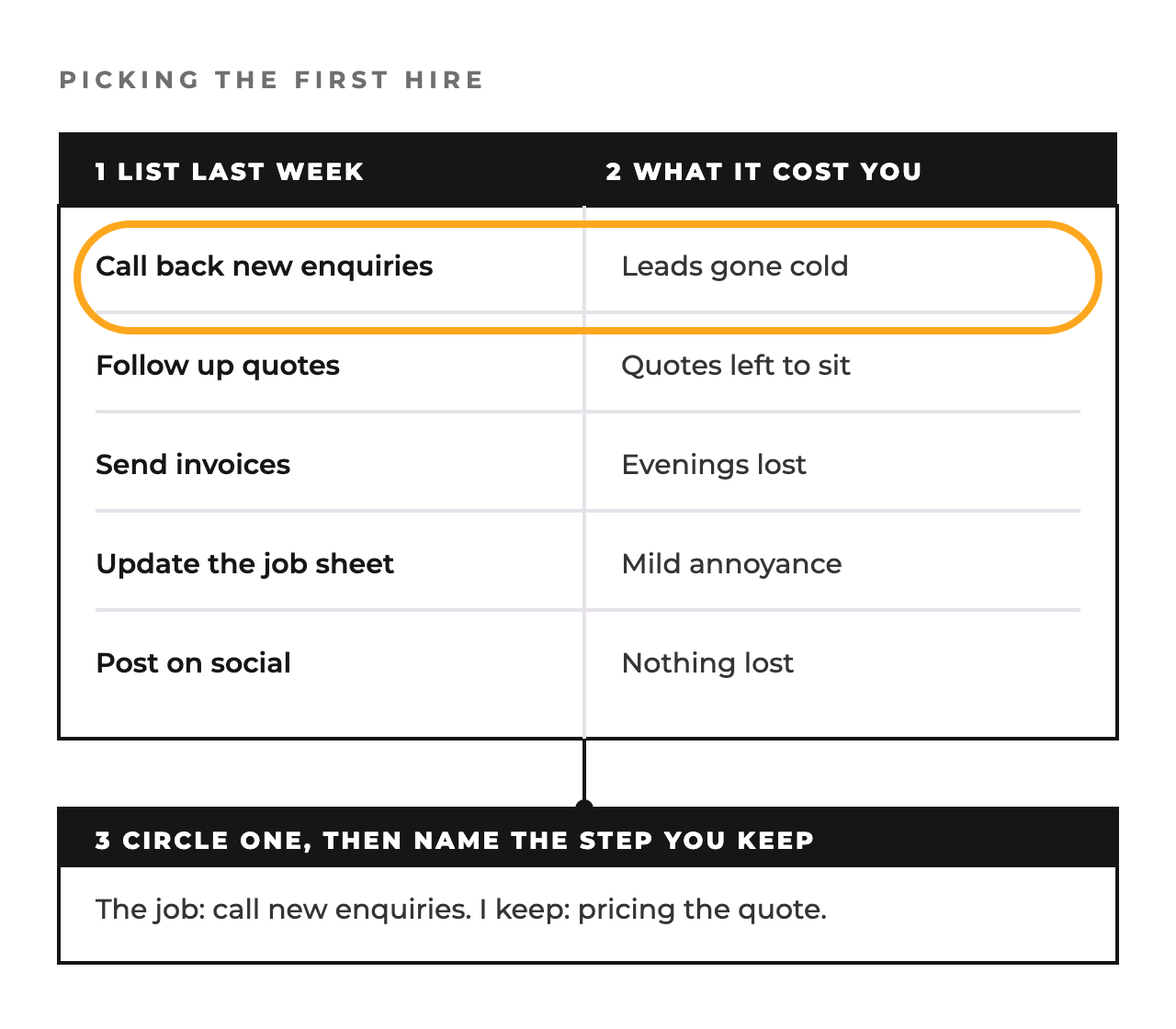
The step you keep is covered below. First, read the list the way you’d read a job ad. Say you run an aesthetic clinic and you’re losing sales because warm leads aren’t called back at the right hour. That is a job you can write down. Call new enquiries fast, follow a fixed run of attempts, book a consult, and pass any clinical question to someone qualified.
Compare that with a brief that asks for someone to work across several systems and get things in order. That’s a hope. Nobody can start on it until you’ve written down who does what today.
Find the one constraint
Owners often ask me for one person who can do it all. My view: hire for your biggest constraint first, and the rest can wait.
Ask which single problem, once it’s solved, makes the others easier or removes them. If you run a clinic, it could be the phone. For a trades business, it might be quotes that don’t get followed up, or invoices sent late. Solve that one with one person, and you’ll see what the second hire should be.
Make the decision before you advertise
You can’t hand over a decision you haven’t made yet. This year, about two in five owners we mapped handovers to a remote hire with held a process out of the handover because they hadn’t settled how it worked, or were about to change it. We cover the processes owners hold back until settled in a separate article.
The processes held back included pricing that lived only in the owner’s head, a finance routine with no fixed method, and invoicing waiting on a new software integration.
The same goes for the small rules: which days you quote, and who sets job start dates. Each has to be decided before a new person can follow it.
Before you advertise, check three things for the job you picked:
- You can describe each step in the order it happens.
- Every rule has one version: the days, the thresholds, the point where it comes back to you.
- The person has access to what they need, and you’ve decided who gives it.
If any of those is missing, finish that first. Hiring into an undecided process just gives the confusion to someone else.
Keep one step and hand over the rest
About two in three owners we mapped handovers to a remote hire with this year passed over the repeatable work first and deliberately kept one decision. The kept step was usually the one carrying money, a customer commitment or legal exposure. That meant authorising payments, sending quotes, taking sales calls, signing contracts or approving a client email. We cover this in the one step owners keep.
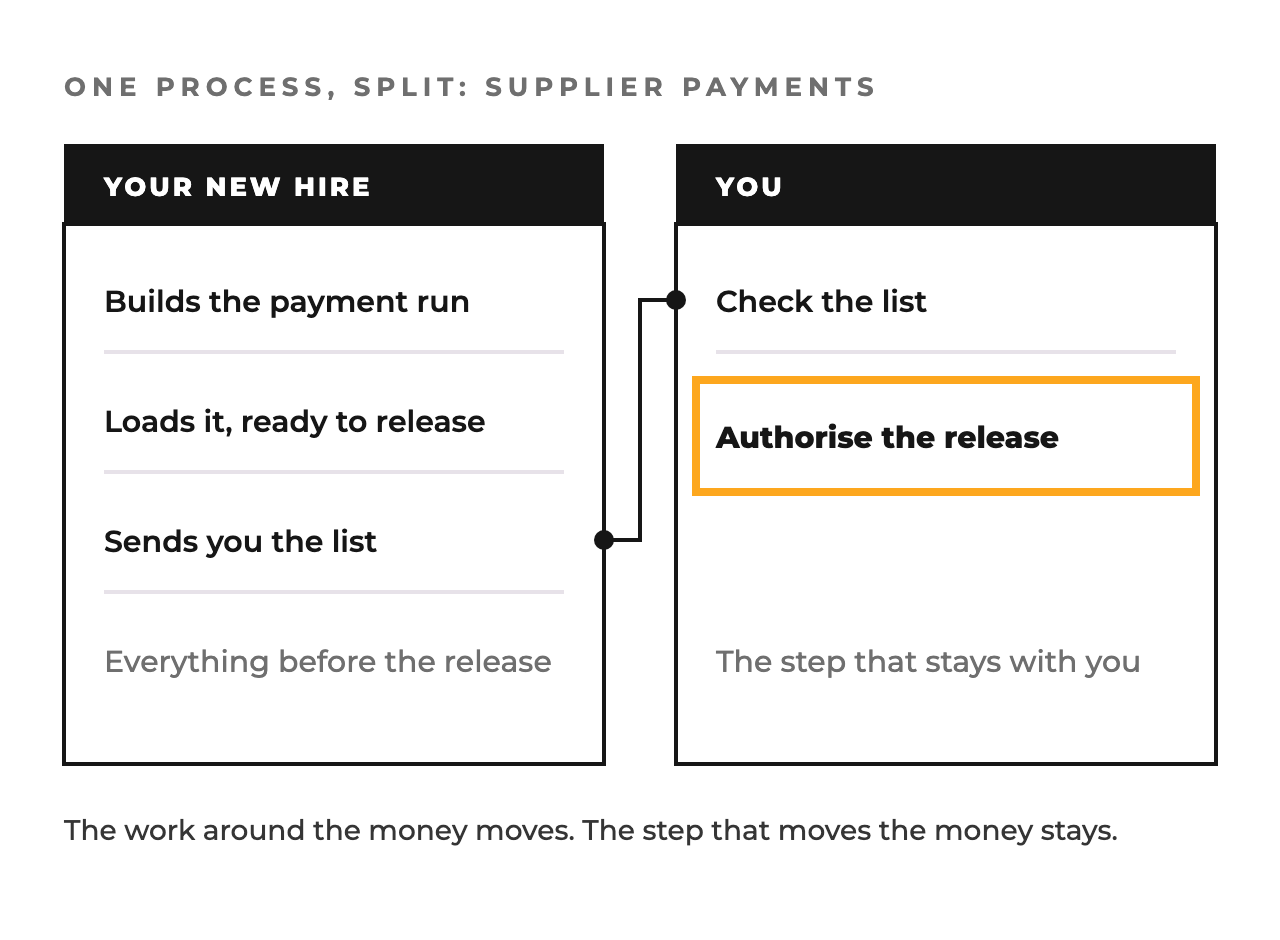
I’d do the same. Keep the one step that moves money or commits you to a customer, and hand over everything around it. Supplier payments are one example: the hire builds and loads the payment run and sends you the list, and you authorise the release.
Here is what that looks like at task level. Picture a trades business whose first admin role takes:
- the first phone call to every new enquiry, with the qualifying questions
- site visits booked into the calendar, grouped by area to avoid back-and-forth across town
- materials ordered from the job card
- deposit and final invoices sent in Xero
- unpaid invoices chased with a call and an email at day seven and again at day fourteen
The owner still runs the site visits, sets the prices and manages the crews. Those are the decisions that stay. Anything the new person isn’t yet authorised to decide comes back to the owner. For more on sorting tasks like this, see what to hand over first.
Compare that with a brief that says “I need an admin person”. The list above can be trained and checked. The brief can’t.
My view: the first hire is a system as much as a person
In my view, the system a new hire walks into matters as much as the person you hire. A good person in a loose system will spend the first month guessing.
I’d rather you hire for one job done well than for a unicorn who does it all. The search for a unicorn is why many owners are still doing everything themselves.
How to hire, in order
Hire when the job you circled costs you more than the person would, counting lost sales, late payments and your own hours. After that, the order matters:
- Pick the one job, and name the step you keep.
- Settle the process: the steps, the rules and the access.
- Check the award that applies to the job.
- Write the ad from the steps you described, and interview against the rules you’ve fixed.
- Sort the paperwork before the person starts.
- Plan a first week made of the easiest steps of the job you picked.
What to sort out on paper
Once the job is clear, sort the setup before the person starts. The government’s hiring guide covers:
- the tax file number declaration
- the super choice form
- the award that applies to the job
- the Fair Work Information Statement
- workers compensation insurance
- reporting pay through Single Touch Payroll
Check it against your own situation with your accountant. A contract written before you know the job gets rewritten once the job takes shape, which is why the job comes first.
If you’re weighing a local hire against a remote one, the job decision is the same either way.
Where a Role Plan call fits
Many owners I talk to have a pile of tasks, a feeling of being behind and no clear first hire. That’s normal, and it’s where a conversation helps.
HIPPO VA places remote staff with Australian service businesses, and our people stay twice as long as the offshore average. On a Role Plan call, we work out which role moves first and what stays with you. If you’re not ready to book, the Work & Energy Tracker is a good first step.
Ready to build
your back office?
Book a call with Dusty. We work out the first role to hire, and afterwards you get your Role Plan in writing.
Related articles

Clean-Up Comes Before the Daily Routine
In about one in four roles we mapped this year, the first task was clearing a backlog before any daily routine could start. What that backlog looked like.

A Five-Minute Lead Target and the Intake Behind It
A trades business set a five-minute call-back target while leads arrived only by email, with no alert. Why intake comes before the response target.

The Signal That Lets an Owner Step Back
An owner stepped back from a remote role and had no regular view of what was done. The setup behind it, and the signal agreed for the new role.